A $500 million startup in winter, a $2 billion one by autumn
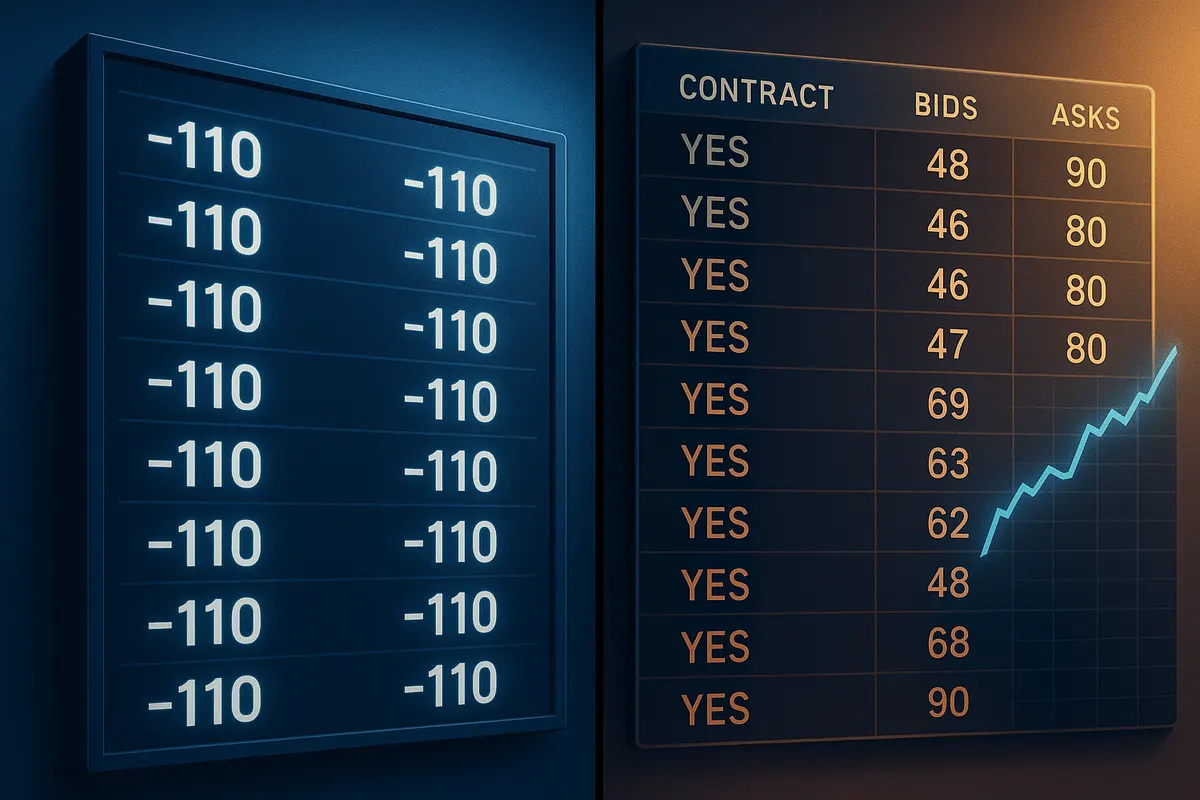
Picture the same bet in two places. In one, a sportsbook quotes you -110 on both sides of a point spread and keeps the difference whichever way the game falls. In the other, you post a price and wait for another person to take the other side of it. Same game, same opinion, completely different plumbing underneath. That second version is the business that just got repriced: the Novig valuation reportedly reached $2 billion in a freshly completed funding round, according to multiple outlets citing people with knowledge of the deal.
What makes the number worth a second look isn’t the size. It’s the slope. Seven and a half months earlier, Novig closed a $75 million Series B at a $500 million valuation, led by Pantera Capital with existing backers Forerunner, NFX and Perceptive Ventures alongside Edge Equity, Makers Fund and Multicoin Capital. A fourfold jump in under eight months is not the behaviour of a mature betting operator. It’s the behaviour of a company that investors think just got handed a key.
The key was federal, not state
In June, the Commodity Futures Trading Commission granted Novig Designated Contract Market (DCM) status. That label is the entry requirement for running a regulated prediction market in the United States, and it changed Novig’s map overnight. Instead of applying for a sports betting licence state by state, a sports-only yes/no exchange with DCM status can offer its contracts across nearly the entire country. Novig is currently live in 47 states, with Arizona, Michigan and Nevada the exceptions.
That is the whole story in one sentence. Operators chasing conventional US sports betting platforms have spent a decade grinding through state legislatures, licence fees and tax rates that differ wildly from one border to the next. A federally regulated event contract venue sidesteps that queue. Reports suggest investor appetite for Novig jumped sharply after the DCM approval landed, which tracks: the addressable market went from “wherever we can get licensed” to “almost everywhere”.
It would be naive to call that settled. Treating sports event contracts as derivatives rather than wagers has drawn objections from state gaming regulators and tribal operators who argue the activity is sports betting by another name, and the question of who gets to regulate it is still being fought out. Anyone reading a $2 billion valuation as a verdict on that fight is reading too much into a funding round.
Exchange versus sportsbook: where the money actually comes from
This is the part most coverage skips, so let’s be precise about it. A sportsbook is your counterparty. It sets prices with a margin baked in, and that margin is its revenue. Two-way market at -110 on both sides implies 52.38% probability on each outcome, or 104.76% in total. The roughly 4.8% overround works out to a hold of about 4.5% of money wagered. You are not betting against other bettors. You are betting against the house, and the house has priced itself a cushion.
A peer-to-peer sportsbook or event contract exchange flips the counterparty. You trade against another user who holds the opposite view, and the platform’s income comes from fees or commission on activity rather than from a built-in price margin. Fee structures differ between venues and change over time, so read the current terms rather than trusting a marketing line. The headline point stands anyway: on an exchange, your cost is explicit and your opponent is another human, not a risk desk.
| Feature | Traditional sportsbook | Peer-to-peer prediction market |
|---|---|---|
| Who takes the other side | The operator | Another trader |
| Oversight | State gaming regulators, licence by licence | CFTC, via Designated Contract Market status |
| Where it can operate | Only in states that have legalised and licensed it | Nationally, subject to the federal framework (Novig: 47 states) |
| Operator revenue | Margin built into the price (hold) | Fees or commission on trading activity |
| Price discovery | Set by the book, adjusted for liability | Set by supply and demand in the order book |
| Position before the result | Bet is generally locked once placed (cash-out at the book’s price) | Contracts can often be traded out as prices move |
| Main practical weakness | Limits and account restrictions for consistent winners | Thin liquidity on less popular markets |
Neither column is a cheat code. On an exchange, if nobody wants your price, you get no bet. Liquidity concentrates in marquee games and mainstream markets, which is exactly why the more obscure props stay the sportsbook’s territory. And no structure removes the basic reality that most participants lose money over time; the exchange model changes who takes the other side of your position, not the arithmetic of being wrong.
The Sydney Sweeney equity line is the most revealing detail
Novig’s ad campaign starring Sydney Sweeney has been running for several weeks and has already drawn public criticism, including a rebuke from female athletes over its tone. The business detail matters more than the controversy. Sweeney didn’t take standard cash compensation for the commercials. She asked for, and received, an undisclosed equity stake.
Nobody outside the cap table knows how large it is. But the maths is easy to run: at a $2 billion valuation, even half a percent would be worth about $10 million, set against a net worth estimated at $40 million to $50 million before any Novig holding. That is a meaningful bet on a betting startup by someone with no obvious reason to take equity risk.
Why it’s revealing: celebrity equity deals are a marker of how founders and their advisers price attention in a crowded category. Paid endorsements are an expense. Equity is a shared wager on distribution. When a talent’s team pushes for stock instead of a fee, it’s a signal that both sides expect the valuation to run. It also explains the aggressive creative. A nationally available product with no state-by-state rollout needs national awareness fast, and provocation is cheaper than media spend.
Scale check: don’t mistake momentum for size
Novig says more than 250,000 traders across the US have driven $6.5 billion through the platform, per its own website. Impressive for a company at this stage, and consistent with its reputation as one of the fastest-growing names in prediction market betting, helped by a sports-only focus that keeps the product legible to people who already follow games.
Now the reality check. The two largest prediction market operators carry a combined valuation of roughly $60 billion. Novig at $2 billion is a rounding error against that, and a long way from the heft an initial public offering would require. No IPO plans have been announced; the stated focus is expanding the peer-to-peer platform and growing the user base. Treat the $2 billion as a private mark set by a handful of investors in a hot sector, not a market price.
The verdict
If you only care about the number, this is one more entry in a long run of betting startup funding headlines. If you care about structure, it’s more interesting than that. A quadrupled valuation in eight months, triggered by a regulatory approval rather than a product launch, tells you where the smart money thinks the next decade of American betting gets decided: in federal derivatives rules, not in state statehouses.
For bettors, the practical read is narrower and more useful. Exchange pricing can be sharper than a bookmaker’s margin on liquid markets, and the ability to trade out of a position before the final whistle is a genuine difference in how a wager behaves. Against that, liquidity is uneven, the fee model deserves a careful read, and the legal framework is still contested. Pick the venue that fits the market you want, understand what you’re paying either way, and keep your stakes inside limits you set before you open the app. If betting stops being entertainment, the tools to set deposit limits, take a cool-off or self-exclude exist for exactly that reason.
FAQ
What is Novig?
Novig is a sports-only peer-to-peer exchange where users trade yes/no event contracts against each other rather than against a bookmaker. It holds CFTC Designated Contract Market status, granted in June, and is live in 47 states.
How much is Novig worth?
Reports citing unnamed sources put the Novig valuation at $2 billion following a recently completed financing round. Its previous round, a $75 million Series B led by Pantera Capital, valued the company at $500 million about seven and a half months earlier.
Why isn’t Novig available everywhere?
DCM status allows it to operate in nearly all 50 states, but the platform is currently live in 47, with Arizona, Michigan and Nevada outside its footprint.
Is a prediction market the same as sports betting?
Economically the exposure is similar, but the legal and operational frameworks differ: event contracts fall under federal CFTC oversight as derivatives, while sportsbooks are licensed by individual states. That distinction is currently being challenged by state regulators and tribal operators.
Does the exchange model give you better odds?
Sometimes the pricing is tighter, because there is no bookmaker margin built into the quote. But you still pay a fee or commission, you need someone to take the other side, and no structure changes the fact that outcomes are uncertain and losses are the common result over time.