
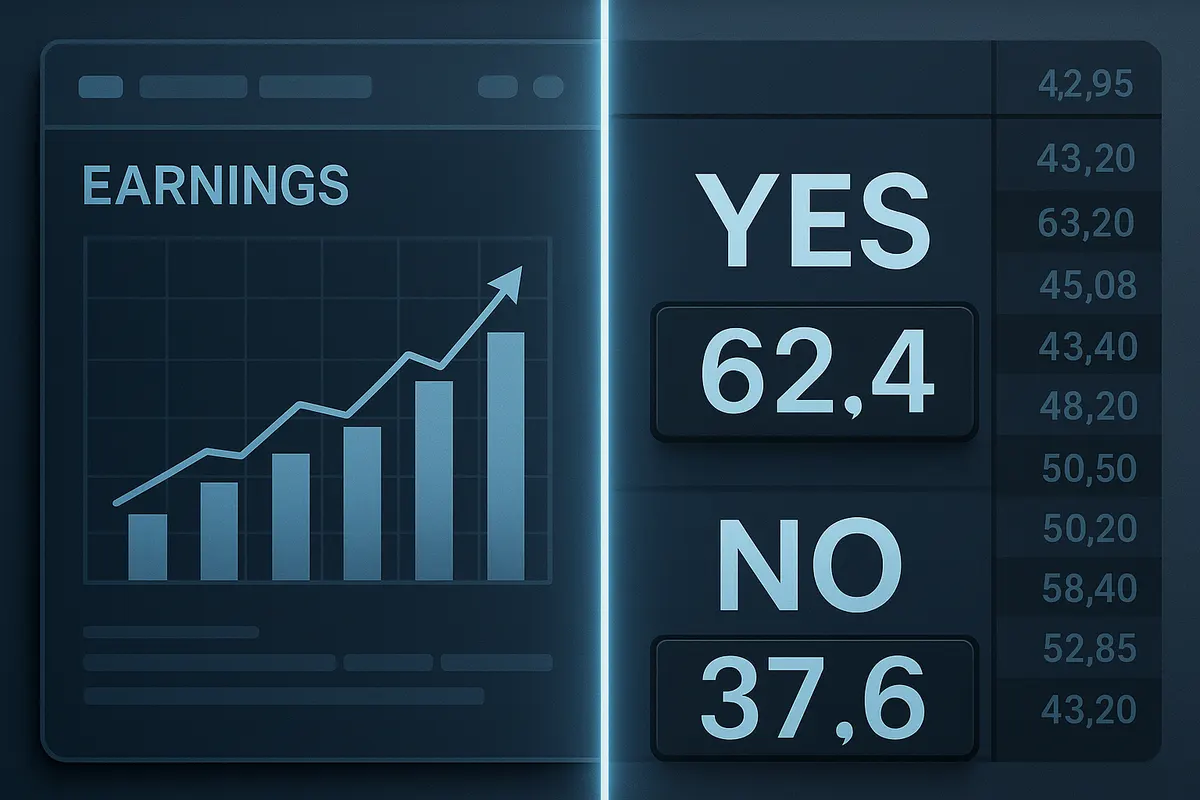
100 metrics, 23 companies, one broker at the front of the queue
Cboe’s filing covers binary derivatives tied to roughly 100 key performance indicators across 23 public companies. Robinhood Markets (NASDAQ: HOOD) announced at its third annual HOOD Summit in Houston that it will be the first retail broker to list them. Pending regulatory approval, Cboe has indicated the contracts could go live as early as October, which would line up with the start of third-quarter earnings season.
The names in that group of 23 are the ones retail traders actually watch: Apple, Tesla, Coinbase Global, SpaceX, and Robinhood itself. The underlying data points are deliberately narrow and checkable. Not “will the stock go up,” but things like iPhone sales, SpaceX rocket or satellite launches, or deliveries of a specific Tesla model.
That is the whole story in one sentence. The more interesting question is what one of these cboe earnings event contracts actually does when you buy it, because the answer sits somewhere between a stock trade and a sports bet, and the paperwork says one thing while the payoff structure says another.
Follow one contract from screen to settlement
Take a hypothetical to make the mechanics concrete. Say the listed question is whether Apple reports iPhone revenue above a set strike for the quarter. Two outcomes, nothing in between. Either the reported figure clears the strike or it doesn’t.
A binary contract settles at a fixed value if the condition is met and at zero if it isn’t. The price you pay in between is just the market’s implied probability. If the “yes” side trades at 0.35 on a contract that settles at 1.00:
- You risk 0.35 per contract. That is your maximum loss.
- If the condition is met, you collect 1.00, for a profit of 0.65 per contract.
- If it isn’t, the contract expires worthless.
- The 0.35 price implies a 35% chance. Flip it: the “no” side should be worth roughly 0.65.
Then earnings drop. The number is published, the contract settles against it, and the position is gone the same evening. No overnight gap risk, no position to manage, no dividend, no vote, no claim on anything Apple owns. You were never exposed to the share price at all, only to a single line in a press release.
Compare that with the two conventional ways of expressing the same view. Buy the stock and you own a slice of the business, with open-ended upside and downside. Buy a call option and your payoff curves with the share price, decays with time, and swells or shrinks with implied volatility. The binary strips all of that out and replaces it with a yes/no ticket. Simplicity is the product.
Three ways to trade the same earnings view
The distinctions matter more than the labels, so here they are side by side.
| Feature | Cboe KPI event contract | Existing prediction-market corporate contracts | Shares or listed options |
|---|---|---|---|
| What you’re trading | A specific company metric or corporate event | Mostly stock price levels, M&A, IPO filings | The share price itself |
| Payoff shape | Binary: fixed amount or zero | Binary | Continuous, scales with price |
| Ownership of the business | None | None | Shares: yes. Options: indirect |
| Venue type | SEC-registered US securities exchange | Designated contract markets (DCMs) | SEC-registered securities exchange |
| Maximum loss | Premium paid | Premium paid | Shares: full stake. Long options: premium |
Where the house edge hides in a binary
Both Cboe and Robinhood are waiving fees on the KPI event contracts through the end of the year. That removes the visible cost, not the real one.
In any two-sided binary market, look at what the yes and no prices add up to. If yes is offered at 0.38 and no is offered at 0.65, the pair costs 1.03 to buy both sides of a market that can only pay 1.00. That 3% gap is the same arithmetic a bookmaker’s overround uses, and the same arithmetic behind a casino’s house edge. It is the cost of transacting, and it does not disappear because the commission line reads zero.
The practical consequence: a trader with no genuine informational edge on, say, quarterly delivery numbers should expect to lose roughly that spread over many trades, before any explicit fees return in January. Narrow, well-researched questions attract people who do have an edge, including analysts who model these metrics for a living. That is a tougher table than most retail traders are used to.
Why Cboe wants these treated as securities
This is the part of the announcement with the longest tail. Cboe’s framing is explicit: the KPI binary options are meant to let investors take positions on company metrics and corporate events “through Securities and Exchange Commission (SEC)-regulated products traded on Cboe’s registered U.S. securities exchange.” The company argues this differentiates its contracts from similar event-based products already trading on designated contract markets, and it points to the transparency, oversight and investor protections of the US securities markets, plus what it calls the benefit of federal preemption of state securities registration requirements.
Unpack that last clause. The sports event contracts that have driven prediction-market volume sit on CFTC-regulated designated contract markets, and they have spent the past year under sustained pressure from state gambling regulators who view them as wagers. Routing corporate event contracts through a securities exchange instead puts them inside a regime where federal rules preempt state securities registration. It is a structural answer to a legal fight, and it is why a filing about iPhone units is more consequential than it sounds. Cboe submitted its request to the SEC in July; approval is still the gating item.
Event betting versus investing, and why the line is blurring
Prediction markets are the fastest-growing business line in Robinhood’s history, and most of that growth came from sports. Bernstein analysts have projected Robinhood’s prediction market revenue could reach $1.7 billion by 2028. The KPI contracts aim at a different instinct: the reason most customers opened a Robinhood account in the first place, which was to trade financial markets.
So is buying one of these investing or betting? Honestly, the distinction is less about the venue and more about three things:
- What the payoff is attached to. A share has a claim on earnings and assets over time. A binary on a single metric has a claim on one number on one date.
- Whether you have an edge. A forecast grounded in supply-chain data or shipment tracking is analysis. A hunch about whether a launch slips is a coin flip with a spread attached.
- How you size it. Binaries lose 100% of the premium when they miss. A string of near-misses on correct-but-early views returns nothing, which is not how a stock position behaves.
Call it event betting or call it earnings derivatives; the maths is the same either way. The regulated wrapper changes who supervises the market and what disclosures you get. It does not change the fact that each contract is a fixed-odds proposition with a cost of entry baked into the spread.
What to watch between now and launch
A few specifics will tell you whether these contracts become a real market or a curiosity:
- Approval timing. Nothing lists until regulators sign off, and a slip past earnings season blunts the natural demand window.
- Strike design. Whether strikes cluster tightly around consensus estimates or sit far out determines whether prices carry useful information or just cheap lottery tickets.
- Settlement clarity. Metrics like iPhone revenue or model-specific deliveries need an unambiguous published source. Ambiguity in a binary is a dispute waiting to happen.
- Two-sided liquidity. Check the yes/no sum before trading. A wide combined price is the tell that the market is thin.
- What happens in January. When the fee waiver ends, the stated cost reappears on top of the spread.
The HOOD Summit also brought weekend trading in selected equities and ETFs and plans for AI trading bots, which tells you where the product strategy is pointed: more hours, more automation, more ways to take a position. The Cboe tie-up is the piece that pulls prediction-style markets back toward the professional trading community rather than the sports book.
One last practical note. Fixed-odds products are engineered for fast, repeated decisions, and that is exactly the pattern that leads people to trade more than they intended. Set a hard limit on what you put at risk per earnings season, treat the premium as money that can go to zero, and if the activity starts feeling like action rather than analysis, step away from it. Educational framing aside, nobody is owed a payout here.