
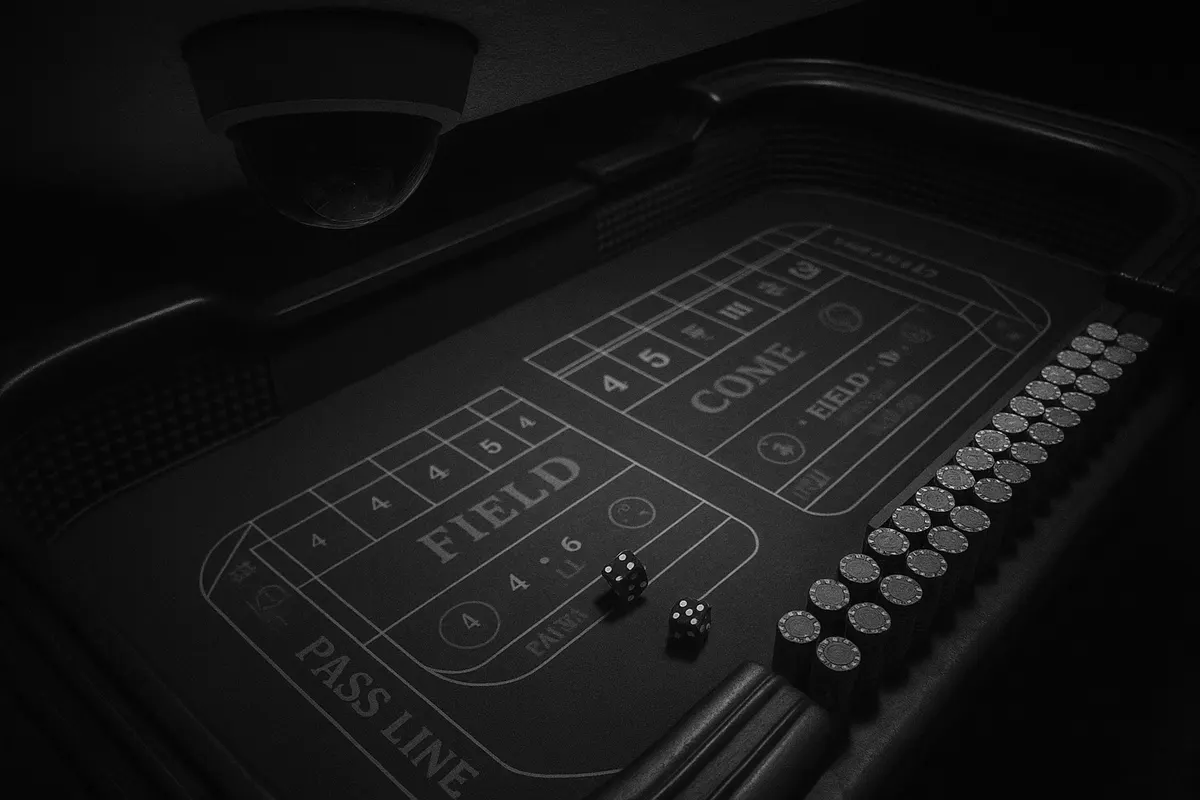
Isn’t cheating a casino a job for outside crews with hidden gadgets?
Mostly, no. The person best placed to take money out of a casino is usually the one being paid to run the game. The latest casino craps cheating scheme to reach a federal courtroom is a textbook example: a dealer at Harrah’s Cherokee Valley River in Murphy, North Carolina has agreed to plead guilty to helping defraud his own employer of more than $131,000, and almost all of it went out the door in a single afternoon.
Lateek Kahmal Taylor, known as “Tray,” had worked at the tribal casino since around 2014. According to court documents, he was dealing the property’s Quartz hybrid electronic craps game and conspired with Donta Dewayne Harris, also known as “Johnny Mathis,” plus others, to rig results between July 18 and August 31, 2024. Taylor’s plea hearing is set for October 9 in federal court in Asheville. Harris pleaded not guilty to all charges on August 12 and asked for a jury trial; he is presumed innocent.
How do you take $132,000 off a craps table in a few hours?
By controlling the record of what the dice did, rather than the dice themselves.
On the Quartz game, Taylor worked as the stickman. He ran the pace of the game and typed each roll’s result into a computer terminal. That terminal entry, not the plastic cubes sitting on the felt, is what the system treats as the official outcome. Prosecutors say the scheme exploited exactly that in two ways:
- When Harris was shooting, Taylor would sometimes declare a losing throw a “bad roll” that didn’t count, and hand the dice back for another go.
- Other times he skipped the pretence entirely and entered a winning result regardless of what the dice showed.
The filing gives one timestamped example. At 2:26 p.m. on August 26, 2024, Harris rolled a 6 and a 3. Taylor entered a 6 and a 4. One pip, and a losing roll became a winning one. Which specific bets were live isn’t spelled out in the documents, but that is the nature of craps: a single number resolves a whole cluster of wagers at once, so falsifying one roll can swing several bets in one keystroke.
The coordination was not subtle. Harris would text Taylor to find out when he was working, then show up with a group of players and direct them on how and where to bet while Taylor dealt. Over several hours on August 26, the Quartz table lost $131,858.36. Harris handed Taylor roughly $45,000 in cash across the month the scheme ran, which is a poor split for the man carrying all the employment risk.
Why couldn’t the casino just absorb a bad day?
Because craps doesn’t produce days like that, and the house knows precisely how much variance it should expect.
Craps is one of the better-value games on the floor if you stick to the right bets, but the edge still belongs to the casino on every wager, and it never moves. Here is roughly where the main bets sit:
| Bet | House edge |
|---|---|
| Don’t pass | 1.36% |
| Pass line | 1.41% |
| Place 6 or 8 | 1.52% |
| Place 5 or 9 | 4.00% |
| Field (2:1 on 12) | 5.56% |
| Place 4 or 10 | 6.67% |
| Hard 6 or 8 | 9.09% |
| Any 7 | 16.67% |
A pass-line bettor is giving up about 1.4% of each wager on average over the long run. Flip that around and the arithmetic gets uncomfortable for anyone trying to hide a six-figure hole: a table bleeding $131,858 would need an enormous, implausible volume of honest action to explain it as bad luck. Casinos reconcile drop and hold per table, per shift, and compare them against the expected figures. A single craps table losing six figures in an afternoon isn’t a variance story. It’s an alarm.
How does casino surveillance actually catch something like this?
Not usually in a single dramatic moment. It’s reconciliation first, then video.
The anomaly in the hold figures tells auditors which table and which shift to look at. From there, surveillance pulls the recorded coverage of that table for those hours. Casino floors are blanketed with cameras, and table games carry dedicated angles on the layout, the chips and the dealer’s hands precisely so that results can be re-examined after the fact. In tribal gaming, that monitoring sits inside a framework of internal control standards overseen by a tribal gaming commission and the federal National Indian Gaming Commission.
The hybrid electronic format made the review easier, not harder. Every entry Taylor made carried a timestamp, which is why prosecutors can point to 2:26 p.m. and state exactly what was keyed in. Line up the terminal log against the video of the dice, and discrepancies stop being arguable. The digital layer that created the vulnerability also created the evidence.
The rest is ordinary investigative work: dealer-player association (the same shooter winning heavily only on one dealer’s shifts is a pattern, not a coincidence), text messages establishing scheduling, cash movements, and the voucher trail. Because the property sits on tribal land, the case went federal, and a grand jury indicted both men in April on charges of theft from an Indian gaming establishment, wire fraud and money laundering, with the indictment noting help from others “known and unknown.”
Where does a money laundering charge come from in a craps scam?
From the cash-out, not the cheating.
Prosecutors allege the group redeemed Ticket-In, Ticket-Out (TITO) vouchers holding the proceeds in transactions structured to disguise where the money came from and who owned it, and to stay under state and federal reporting thresholds. Casinos are treated as financial institutions for anti-money-laundering purposes in the US, which means large cash transactions trigger mandatory reports. Breaking a win into smaller voucher redemptions to duck those filings is its own offence, independent of how the money was won. Prosecutors are seeking forfeiture of at least $131,858.36.
That detail is worth sitting with. Even if the craps fraud had somehow gone undetected on the floor, the cash-out behaviour leaves a paper trail that compliance teams are legally obliged to scrutinise.
What happens next in the case?
Two different tracks. Taylor’s plea agreement means his part of the matter moves to sentencing rather than trial; federal wire fraud and money laundering counts carry statutory maximums measured in years, though actual outcomes turn on the sentencing guidelines, the loss amount and any cooperation. Harris is contesting the charges and remains subject to conditions of release, with his next docket call scheduled for November 2.
| Date | Event |
|---|---|
| July 18 – Aug 31, 2024 | Period prosecutors say the scheme operated |
| Aug 26, 2024 | Rigged session costing the casino $131,858.36 |
| April | Grand jury indicts Taylor and Harris on three counts |
| August 12 | Harris pleads not guilty, requests jury trial |
| September 29 | Taylor’s plea agreement filed |
| October 9 | Taylor’s plea hearing, federal court in Asheville |
| November 2 | Next docket call in the Harris case |
Court dates after the 2024 scheme window fall in the following year.
Does a dealer cheating scandal mean the games are rigged against players?
This one ran in the opposite direction. The victim was the casino, which lost $131,858.36 of its own money to a crew that had the dealer on the payroll. That’s the shape of most insider gambling fraud cases: staff steal from the house, because the house is where the money is.
It isn’t entirely victimless for other bettors, though. On a craps table, one falsified roll resolves every live wager on the layout. If the stickman types a 10 when the dice say 9, honest players with money on the wrong numbers get paid or swept incorrectly alongside the conspirators. Nobody in the filing is described as being compensated for that.
The practical lesson for anyone playing is narrow but real. Casino game integrity depends on separation of duties, surveillance coverage, audited internal controls and a regulator with teeth, not on trust. Where a human input becomes the official record, that input is the weak point, and hybrid electronic table games don’t remove the problem so much as relocate it to a keyboard. If you ever believe a result was recorded wrongly, raise it at the table immediately, ask for the pit supervisor, and escalate to the operator’s regulator rather than to the staff member involved. Keep your own notes of time, table and amounts; surveillance footage is time-indexed, which is only useful if you can say when to look.
And the odds themselves were never the thing being manipulated here. The pass line holds its 1.41% edge whether or not the stickman is honest. Treat what you bet as the cost of the entertainment, set a deposit or session limit before you start, and use the self-exclusion and cool-off tools every licensed operator is required to offer if play stops feeling like a choice.