
If someone told you the LA-to-Vegas bullet train is already being built and will be whisking gamblers to the Strip in time for the 2028 Olympics, forget it. Neither half of that is true. The brightline west high speed rail project has no track in the ground, its official completion target has slipped to late 2029, and its corporate family just filed for Chapter 11 bankruptcy protection. Vegas will still be a drive or a flight for years yet.
Here’s what actually happened, why the money dried up, and how to think about LA–Vegas trips in the meantime.
The bankruptcy is real, but it isn’t the Vegas project
Brightline Holdings and roughly 16 affiliated companies filed for Chapter 11 protection in New Jersey. As part of that filing, existing investors agreed to a restructuring support agreement that puts another $490 million into the Miami-to-Orlando railroad in Florida.
Two things to be precise about, because they get muddled constantly:
- Brightline Trains Florida, the entity that actually runs the Florida trains, did not file. Service there is continuing.
- Brightline West is a separate legal entity with overlapping ownership, not a wholly owned subsidiary of the Florida railroad. It isn’t in the bankruptcy either.
A Brightline West spokesperson told the Las Vegas Review-Journal the Florida filing “has no bearing” on the Vegas project and that the company’s focus “remains on completing the financing” and moving forward. Legally, that’s defensible. Practically, it’s harder to swallow, because the Vegas project has not visibly moved in a long time.
The actual problem: a project that has stopped moving
Strip away the corporate structure and the picture is simple. Fortress Investment Group acquired the old XpressWest project in September 2018, and it was subsequently rebranded as Brightline West, though the exact year of the rebrand isn’t clearly documented. There was a ceremonial groundbreaking in April 2024. Early site work on the Las Vegas terminus started in 2025 across about 110 acres, including grading, sewer and storm-drain work, and the beginnings of a parking garage.
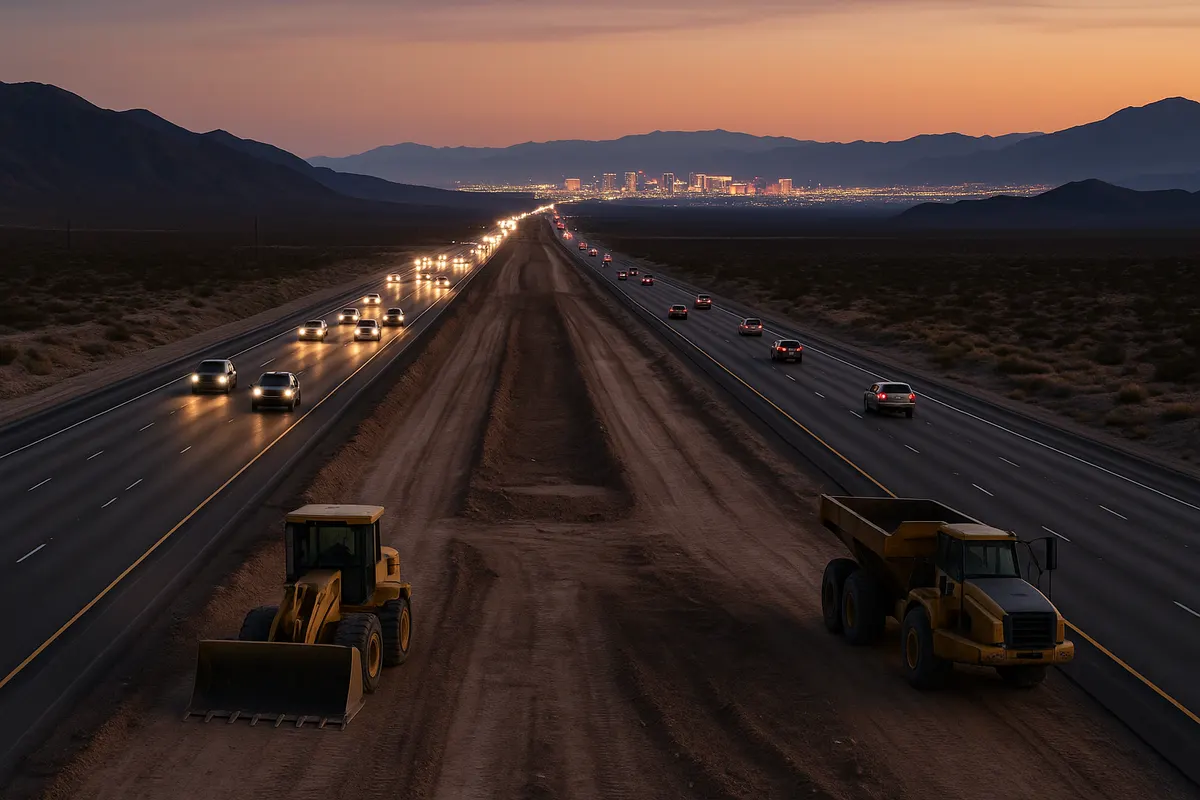
Then it went quiet. Crews have not been seen at the parking garage for at least six months, and no new construction phase has been announced. The heavy work, the part that defines the project, means laying track down the median of Interstate 15 across the Mojave Desert. That has yet to begin at all.
The 2028 Olympics deadline was already gone before the Florida bankruptcy filing. The current target is late 2029, and nothing about a stalled site and an unfinished financing package makes that look comfortable.
The plan on paper
For context, this is what Brightline West says it intends to build:
| Item | Detail |
|---|---|
| Route length | 218 miles, largely in the I-15 median |
| Vegas terminus | Las Vegas Boulevard, between Blue Diamond and Warm Springs roads |
| California terminus | Rancho Cucamonga, with a Metrolink transfer toward Los Angeles |
| Intermediate stops | Hesperia and the Victor Valley |
| Possible future stop | Southern Nevada Supplemental Airport near Jean, Nev. (county hopes to open it 2035–2037) |
| Top speed / journey time | Up to 200 mph; about two hours end to end |
| Cost estimate | $16 billion rising to $21.05 billion per Trains.com; other reports cite a $12 billion original estimate and a rise to about $21.5 billion |
| Completion target | Late 2029 |
What drove the stall: a cost estimate that jumped by billions
The cause isn’t mysterious. After the 2024 groundbreaking, the estimated price tag went from $16 billion to $21.05 billion according to Trains.com, while other outlets report the original estimate as $12 billion and the current figure at roughly $21.5 billion. The baseline number is inconsistent across sources, but the direction is not in dispute. A project whose cost rises by $5 billion or more before the first rail is laid has to go back and re-solve its capital stack from scratch.
Brightline West has around $3 billion in federal funding attached to the project, which sounds enormous until you set it against a $21 billion build. The balance has to come from private capital, and private capital prices risk. A desert corridor with no operating history, a single destination at one end, a commuter-rail transfer at the other, and a parent group now restructuring in bankruptcy court is a harder sell to bond buyers than it was in 2024. That is the real bottleneck: not permits, not engineering, financing.
The Florida bankruptcy compounds the problem even though it is legally separate. Investors looking at Brightline West are now looking at a sponsor whose flagship US passenger rail venture needed a $490 million rescue injection and a Chapter 11 process. Confidence is a currency here, and it just got devalued.
What this means for Vegas trips and casino tourism
Southern California is Las Vegas’s biggest drive-in feeder market, and the I-15 is the pipe that market flows through. The promise of the train was never only speed; it was predictability. A two-hour scheduled ride beats a four-hour drive that turns into six on a holiday Sunday, and it removes the designated-driver problem for a market where a lot of trips involve casino floors and bars.
With that off the table until at least the back end of the decade, three practical consequences follow:
- I-15 congestion stays everyone’s problem. Big fight weekends, Formula 1, major conventions and holiday periods will keep producing the same brutal southbound Sunday crawl. Plan departures around it rather than hoping infrastructure saves you.
- Resorts can’t bank on rail-driven demand. Operators who modelled incremental Californian weekend visits arriving at a Las Vegas Boulevard station in 2028 now have a blank space in the forecast. Expect continued heavy reliance on air lift and drive-in traffic.
- The airport connection is further out still. The mooted station at the Southern Nevada Supplemental Airport near Jean depends on an airport Clark County hopes to open between 2035 and 2037. That’s a next-decade story at best.
Worth noting even in the optimistic case: the California end is Rancho Cucamonga, not Union Station. Reaching central Los Angeles means a Metrolink leg plus a transfer wait. For anyone coming from the Westside or Orange County, the door-to-door maths was always less dramatic than “two hours to Vegas” suggests.
How to plan around it
The fix, for travellers, is to treat Brightline West as a nice-to-have that may arrive in the 2030s rather than a date you can schedule a trip around.
- Price the flight properly. Short-haul LA–Las Vegas fares are often cheap, but add parking, bag fees and airport time before comparing with fuel costs for a car full of people.
- Drive at unfashionable hours. Leaving Vegas late on Sunday night or early Monday morning routinely saves more time than any shortcut.
- Check the event calendar first. Race weekends, big conventions and title fights move both room rates and traffic. The same weekend can cost double for a worse trip.
- Don’t pre-book anything on a 2029 assumption. Until heavy construction actually starts in the I-15 median, the completion date is an intention, not a schedule.
Frequently asked questions
Is Brightline West cancelled?
No. It has not been cancelled, and it is not itself in bankruptcy. The company says it is still working to complete financing. But there is no visible construction progress, and the timeline has already slipped past the 2028 Olympics to late 2029.
When will the LA to Las Vegas train open?
The stated target is late 2029. Given that no track has been laid, the Las Vegas site work appears stalled and the financing package is unfinished, treat that as the earliest plausible date rather than a firm one.
Does the bankruptcy stop the Florida Brightline trains?
No. Brightline Trains Florida, the operating company, did not file, and Miami-to-Orlando service is continuing while investors put a further $490 million into that railroad.
How fast would the Vegas train actually be?
Up to 200 mph, covering the 218 miles in about two hours between Las Vegas Boulevard and Rancho Cucamonga. Add the Metrolink connection and transfer time if your destination is central Los Angeles.
One last thing, since this is a casino-travel subject. Build your trip budget around what the whole weekend costs including transport, decide your gambling spend before you arrive, and use deposit or loss limits and session reminders if you play online on the way. Every casino game carries a built-in house edge, so treat it as entertainment you’ve budgeted for, not a way to fund the trip. If it stops feeling like entertainment, support is available through the National Council on Problem Gambling.