
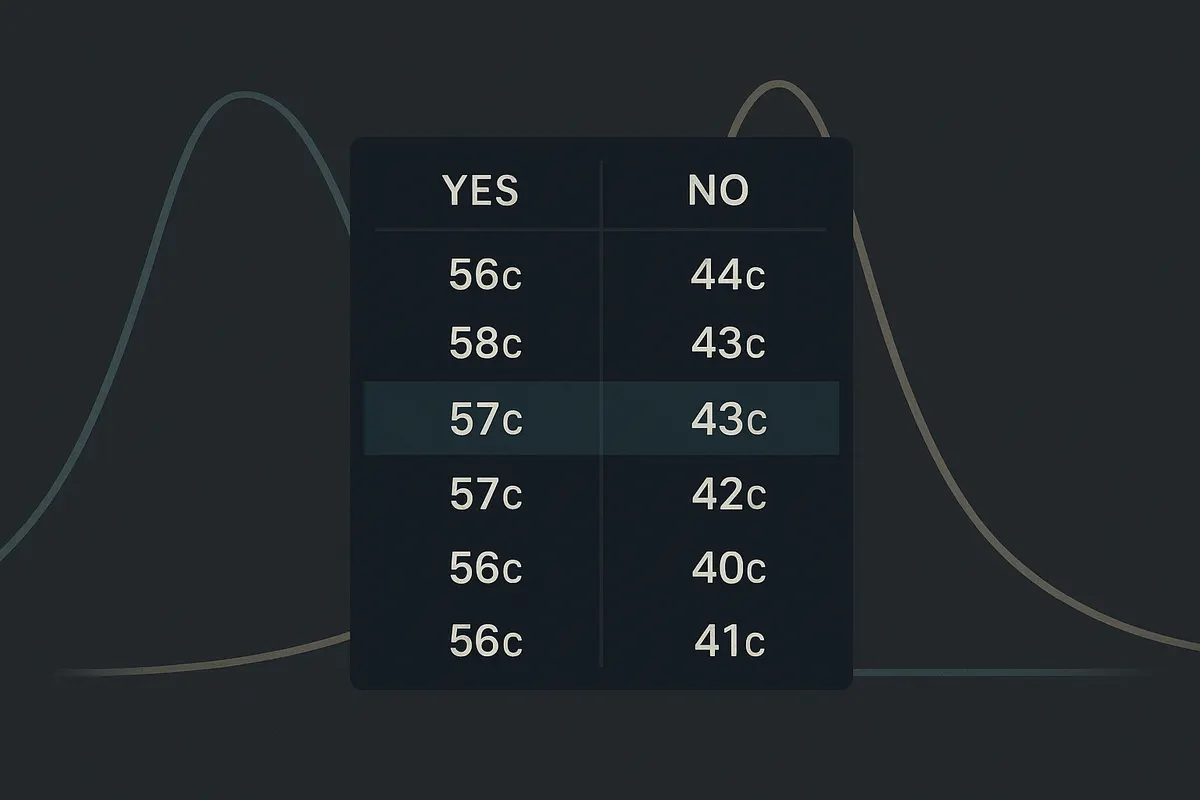
A $90 million valuation for a firm that doesn’t predict anything
Raven, a market maker that entered prediction markets only in the second quarter of 2025, just closed a financing round that values it at $90 million pre-money. That is more than triple the $25 million valuation it carried after a $2.7 million seed round in 2024, led by Hack VC with Wintermute Ventures among the participants. The new round was led by Coinbase Ventures and CMCC Global, and neither disclosed how much it put in.
Here is the part worth sitting with: Raven doesn’t forecast elections, it doesn’t take a view on the Super Bowl, and retail traders have mostly never heard of it. It quotes both sides of event contracts and manages the inventory risk that comes with doing so. The thesis behind the cheque is that prediction market liquidity, the unglamorous plumbing of these platforms, is where the durable business sits. Institutional money isn’t only chasing the brands people bet on. It’s buying the layer underneath them.
What Raven actually does
Raven was founded in 2023 and describes itself as an algorithmic high-frequency trading firm. It makes markets in thousands of event contracts, and that sits alongside market making in traditional financial assets plus liquidity provision for digital assets and token projects across both centralised and decentralised venues. CMCC co-founder Charlie Morris is joining the board.
Strip away the terminology and a market maker does one thing: it stands ready to buy and sell at the same time, so you never have to find another human who wants the opposite side of your trade at the exact moment you want it. On a prediction market, that means posting a bid and an ask on a Yes share, and on the matching No share, and updating both continuously as news moves.
The firm’s income comes from the gap between those two prices and from volume, not from being right about the outcome. In a well-run book, a market maker is close to outcome-neutral by design. That’s precisely why a venture investor can underwrite it: the revenue line doesn’t depend on who wins the election.
Why prediction market liquidity decides what you pay
Event contracts settle at either 100 cents (the event happened) or zero (it didn’t), so the live price doubles as a probability. A Yes share at 62 cents is the market’s collective estimate of a 62% chance. As Gemini’s educational material on market makers puts it, without them prediction markets would be “illiquid, slow, and inaccurate” — participants would wait around for a counterparty, spreads would stay wide, and prices would drift away from honest probability estimates.
That abstraction has a very concrete cost. Take an illustrative thin market where Yes is quoted 55 bid / 65 ask. You buy at 65. Change your mind five minutes later with no news, and you sell at 55. You’ve lost 10 cents on a 65-cent position, roughly 15% of your stake, purely on the spread. Now take a liquid market on the same question quoted 61 / 63. The same round trip costs 2 cents, around 3%. Nothing about the underlying event changed. Only the depth of the book did.
Deeper liquidity also changes what size you can trade without moving the price against yourself, and whether you can exit a position early at a sane price when circumstances shift. For anyone treating event contracts as something more considered than a one-and-done punt, that exit matters as much as the entry.
Prediction markets explained: where the cost sits versus a sportsbook
This is the structural difference people miss when they lump event betting platforms in with online sportsbooks. A traditional bookmaker sets the prices, takes the other side of your bet, and builds a margin into the odds — the overround. An exchange-style prediction market mostly matches users against each other and charges fees, so the pricing edge has to come from somewhere else. That somewhere is the market maker’s spread.
| Traditional sportsbook | Prediction market / event contracts | |
|---|---|---|
| Who sets the price | The operator | The order book, shaped by market makers and traders |
| Who takes your other side | The operator | Another participant, often a market maker |
| Where the cost sits | Built-in margin (overround) in the odds | Bid-ask spread, plus platform or settlement fees |
| Price meaning | Odds implying probability plus margin | Cents per contract, read directly as probability |
| Early exit | Cash-out offered at the operator’s discretion | Sell your position into the book, if there’s depth |
| What better liquidity changes | Little — margin is set by the operator | Tighter spreads, less slippage, larger size absorbed |
Neither model is free. On both, the cost of participation is real and compounds the more you trade. The honest framing is that tighter spreads reduce friction; they don’t flip the economics of frequent betting in your favour.
Coinbase’s prediction market positions are starting to look like a strategy
Coinbase Ventures, the venture arm of Coinbase Global (NASDAQ: COIN), runs a portfolio weighted towards blockchain and crypto businesses. Its prediction market holdings now stack up into something more deliberate than opportunism:
- Raven — the liquidity and market making layer.
- Billy Bets — an autonomous AI agent that trades sports event contracts on platforms including Polymarket.
- Earlybird — a prediction market for trading on future outcomes of privately held companies.
- Limitless — one of the larger prediction markets operating outside the United States.
Read together, that’s exposure to the trading infrastructure, the algorithmic flow that uses it, a niche asset class built on top of it, and an offshore venue. The exchange itself has been building a more prominent footprint in the sector. A venture portfolio spread across the stack is how you bet on a category rather than a single company.
Raven’s repricing also fits a broader pattern of institutional appetite in this space — the same stretch has seen reports of a firm linked to Donald Trump Jr. committing a further $300 million to Polymarket. Valuations in event contracts have moved fast, and infrastructure is being priced alongside the consumer brands.
What this means in practice for people using these platforms
Three practical consequences follow from more capital flowing into crypto prediction markets and their market makers.
- Spreads tend to tighten where competition exists. More well-capitalised firms quoting the same contracts means narrower bid-ask gaps on popular markets. The benefit is uneven: headline elections and major sports will see it first, obscure questions will stay wide.
- Prices become more useful as probabilities. Competitive market making is what keeps a 62-cent Yes genuinely meaning 62%. Thin, poorly made markets are where prices wander, and where a casual participant is most likely to pay far above fair value without noticing.
- You are increasingly trading against professionals. A high-frequency firm with better data and faster execution is on the other side of a meaningful share of retail flow. That is not a reason to avoid these platforms, but it is a reason to drop any notion that event contracts are an easier market than sports betting because they look like finance.
What the $90 million doesn’t tell us
A pre-money valuation is a negotiated number between a private company and its investors, not a verdict on anything. Raven didn’t disclose how much Coinbase Ventures and CMCC committed, so the round’s size is unknown, and a firm that entered prediction markets in mid-2025 has a short track record in them. Market making revenue also depends on volumes holding up, and volumes in event contracts have been driven by a handful of very large news cycles.
The regulatory picture remains the live variable. Event contracts sit on contested ground between financial regulation and gambling regulation, and the rules differ sharply by jurisdiction — which is why a platform like Limitless operates outside the US at all. Infrastructure valuations assume the category keeps growing in its current shape. That assumption is doing a lot of work.
Common questions
What is prediction market liquidity?
It’s the depth of buy and sell interest available in an event contract’s order book at any moment. High liquidity means tight bid-ask spreads, the ability to trade meaningful size without moving the price, and a realistic chance of exiting a position early. Market makers supply most of it.
Is a prediction market the same as a betting site?
Economically they overlap, structurally they differ. You’re buying and selling contracts priced in cents on an order book rather than accepting fixed odds set by an operator, and your cost shows up as the spread and fees rather than as a bookmaker’s built-in margin.
Does Coinbase run a prediction market?
The investments described here were made by Coinbase Ventures, the company’s venture arm, into third-party businesses including Raven, Billy Bets, Earlybird and Limitless. A venture stake is not the same as operating a platform.
Do tighter spreads make event betting profitable?
No. Lower friction means a smaller cost per trade, not a positive expected return. Every participant still pays the spread and any platform fees, and the professional firms on the other side are there because the flow is profitable to them over time.
If you do trade event contracts, treat them as spending money rather than an income strategy, use the deposit and loss limits your platform offers, and step away if the activity stops feeling optional. Support services for gambling-related harm are available in most jurisdictions and apply to event contracts as much as to any casino product.