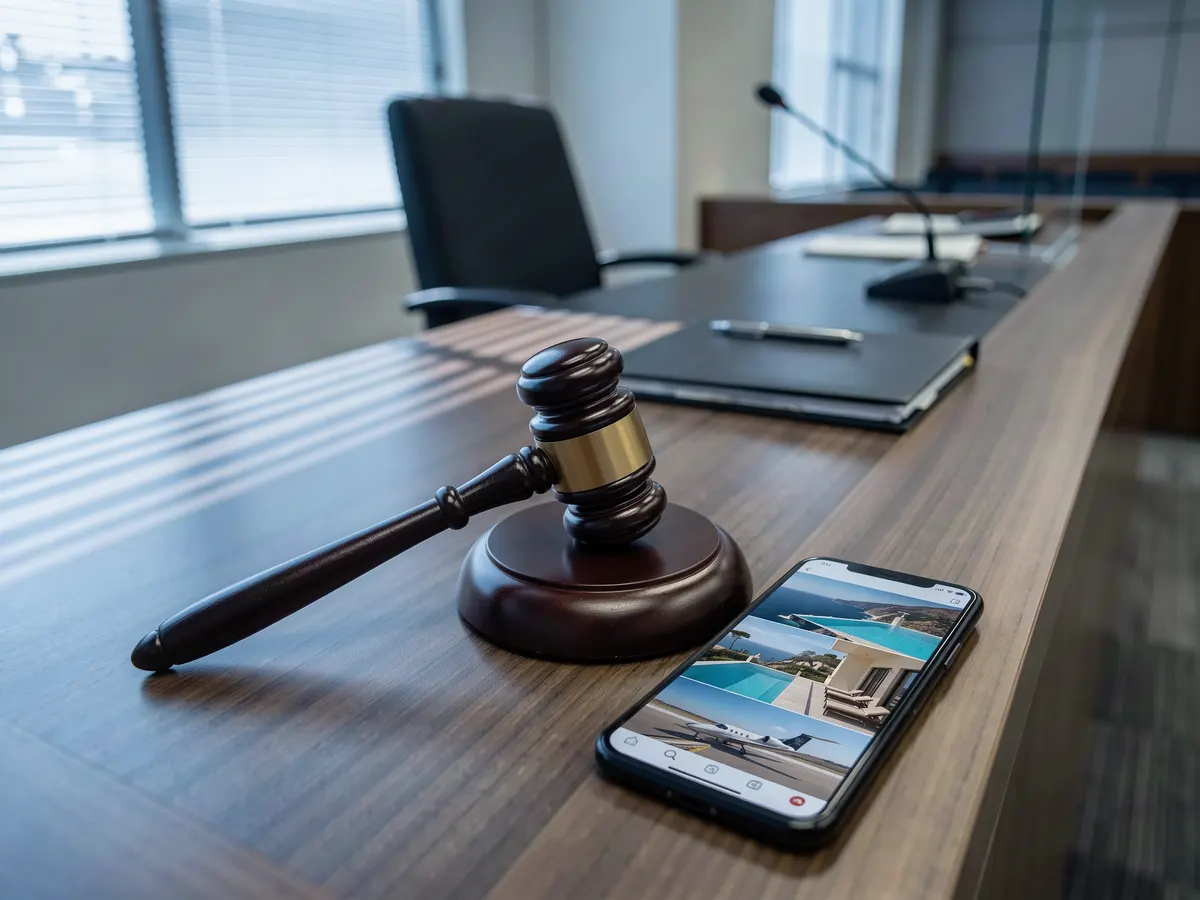
One million dollars. That is the bail District Judge Joe Hardy attached on October 1, 2026 when he signed a second arrest warrant for David Oancea, the Las Vegas handicapper who built an audience of roughly nine million Instagram followers under the name “Vegas Dave.” The first warrant, issued on August 13, carried no bail at all. Oancea responded to that one by posting videos of himself abroad, which is a fairly unusual legal strategy.
The Vegas Dave arrest warrant isn’t a gambling case. No one is accusing him of fixing a game or running an illegal book. It grew out of a dispute over luxury vacation rentals in Mexico, and that is exactly what makes it worth reading carefully. The through-line here is credibility, and credibility is the only product a betting personality actually sells.
It started with blocked guest access, not bad beats
Cabo Platinum, a luxury vacation-rental company operating in Mexico, sued Oancea and accused him of sabotaging bookings at several high-end properties, blocking guest access and interfering with confirmed reservations. In July 2025, District Judge Timothy Williams entered a $30.2 million judgment against him and ordered him to stop disrupting the rentals.
Thirty million dollars is the kind of number that ends a dispute. According to court filings cited by the Las Vegas Review-Journal, it didn’t. Oancea neither paid the judgment nor complied with the injunction.
So in September 2025 the court moved from “pay us” to “hand it over.” Oancea was ordered to surrender a specific list of assets: three Mexican properties, $375,000 in cryptocurrency, a Richard Mille watch, and several Hermès Birkin bags. He had two weeks. He turned over none of it, saying the assets were no longer in his possession.
Where the case turned: a judge saying the words out loud
That claim triggered a six-day evidentiary hearing, which is an enormous amount of judicial time for a question as narrow as “do you still own the watch?” District Judge Tara Clark Newberry’s findings were blunt. She described his testimony as “false,” “inconsistent,” and “evasive,” and wrote: “This court finds that Mr. Oancea was not a credible witness.”
She also found that any claimed inability to comply was, in her words, “self-created, strategic, and the result of voluntary acts to avoid compliance.” Cabo Platinum was awarded nearly $294,000 in attorneys’ fees and about $17,000 in costs on top of everything else.
Then came the part most people misunderstand. Newberry offered two “purge” options:
- Hand over the assets or their cash equivalents, and sign a power of attorney giving Cabo Platinum principal Mishan Andre authority over his Mexican property interests; or
- Surrender to custody and stay there until he complied.
That second option is civil contempt, and it is not a sentence. There’s no fixed term to serve out. The jail door is coercive, not punitive, and the person holding the key is the person in the cell. You leave when you comply. That distinction matters because a lot of the online commentary around this case has treated it like a criminal conviction waiting to happen. It isn’t. It’s a court trying to make a $30.2 million judgment mean something.
How a missed hearing becomes a failure to appear court warrant
On August 13, Oancea’s attorneys showed up for his scheduled surrender hearing. He did not. Attorney Alex LeVeque told the court his client had been informed of the contempt order, then declined to comment on his whereabouts or even on whether he knew them.
A bench warrant followed the same day, with no bail. A failure to appear court warrant is a mechanical consequence, not a judgment call: the court ordered a person to be somewhere, the person wasn’t there, and the court issues an order for law enforcement to bring him in. It doesn’t expire because you’re in a different time zone, and it doesn’t soften because the underlying case is civil.
What happened next is the part that will follow Oancea for years. Rather than going quiet, he posted social media videos of a luxurious trip abroad, later surfacing in Thailand. Six weeks later, he missed court again, and Hardy signed warrant number two, this time with bail set at $1 million.
Read those two warrants side by side and you can see a judge recalibrating. A no-bail warrant says “we want you in custody.” A $1 million bail figure says “if you are picked up anywhere, releasing you is going to be expensive and well documented.” Neither is good news for someone whose brand depends on being reachable.
The sequence, in order
| When | What happened |
|---|---|
| July 2025 | Judge Timothy Williams enters a $30.2M judgment for Cabo Platinum and bars further interference with rentals |
| September 2025 | Oancea ordered to surrender three Mexican properties, $375,000 in crypto, a Richard Mille watch and several Hermès Birkin bags within two weeks; nothing is turned over |
| After a six-day hearing | Judge Tara Clark Newberry finds his testimony “false,” “inconsistent” and “evasive”; awards ~$294,000 in fees and ~$17,000 in costs; sets two purge options |
| August 13 | Oancea misses his surrender hearing; a no-bail bench warrant is issued |
| Weeks later | He posts videos from a luxury trip abroad and surfaces in Thailand |
| October 1, 2026 | Judge Joe Hardy issues a second arrest warrant after another failure to appear; bail set at $1 million |
Why the Vegas Dave arrest warrant should change how you read a tout
Oancea’s public persona was built on documented wins, nine-figure follower counts and a slot in Showtime’s 2019 sports-betting docuseries Action. Nothing in this case says his picks were bad. What it says is narrower and, honestly, more useful: a Nevada judge who spent six days listening to him under oath concluded he was not a credible witness.
That is the whole problem with the pick-selling business. You are not buying handicapping skill, because you can’t audit it. You’re buying the seller’s word about their own record. Screenshots are trivially cherry-picked. “Units” can be redefined after the fact. Losing slips simply don’t get posted. When the only quality control is the seller’s honesty, a formal judicial finding on that exact trait is the single most relevant data point a customer could have.
And the math underneath is unforgiving in a way that marketing never admits. At standard -110 pricing, you need to win 52.4% of your bets just to break even, because you’re risking $110 to win $100. The bookmaker’s margin is baked into the price on both sides. Anyone promising consistent profit is selling a product that has to clear that hurdle every single week, forever, net of their subscription fee. Treat confident claims about long-run profitability as advertising copy, because that’s what they are.
What to actually check before you trust a betting personality
- Verified records only. If a track record isn’t logged by a third party with timestamps at the moment of the bet, it isn’t a record. It’s a story.
- Search the court dockets, not just the feed. Nevada and most US states publish civil case records. A litigation history is public, free to read, and far more informative than a highlight reel.
- Watch how someone handles bad news. Oancea’s response to a bench warrant was content from a private jet. How a person behaves when accountability arrives tells you more than how they behave when things are going well.
- Separate the licensed from the unlicensed. A sportsbook regulated by a state gaming authority has audited finances, dispute procedures and segregated player funds. A person selling picks on Instagram has none of that, and no regulator to complain to.
- Price the subscription into your edge. A $200-a-month service doesn’t just need to be right, it needs to be right by enough to cover itself on top of the vig.
The practical lesson from this stretch of Las Vegas gambling legal news isn’t about one man’s travel plans. It’s that the sports-betting content economy rewards exactly the traits courts punish: confidence without documentation, volume without accountability. Hardy’s $1 million bail figure is a reminder that the gap between an online persona and a verified record eventually gets measured by somebody with subpoena power.
If you bet, bet money you can afford to lose, set deposit and loss limits with your licensed operator, and treat any pick-seller’s guarantee as a reason to walk away. Free, confidential help is available in the US through the National Council on Problem Gambling helpline at 1-800-522-4700.