
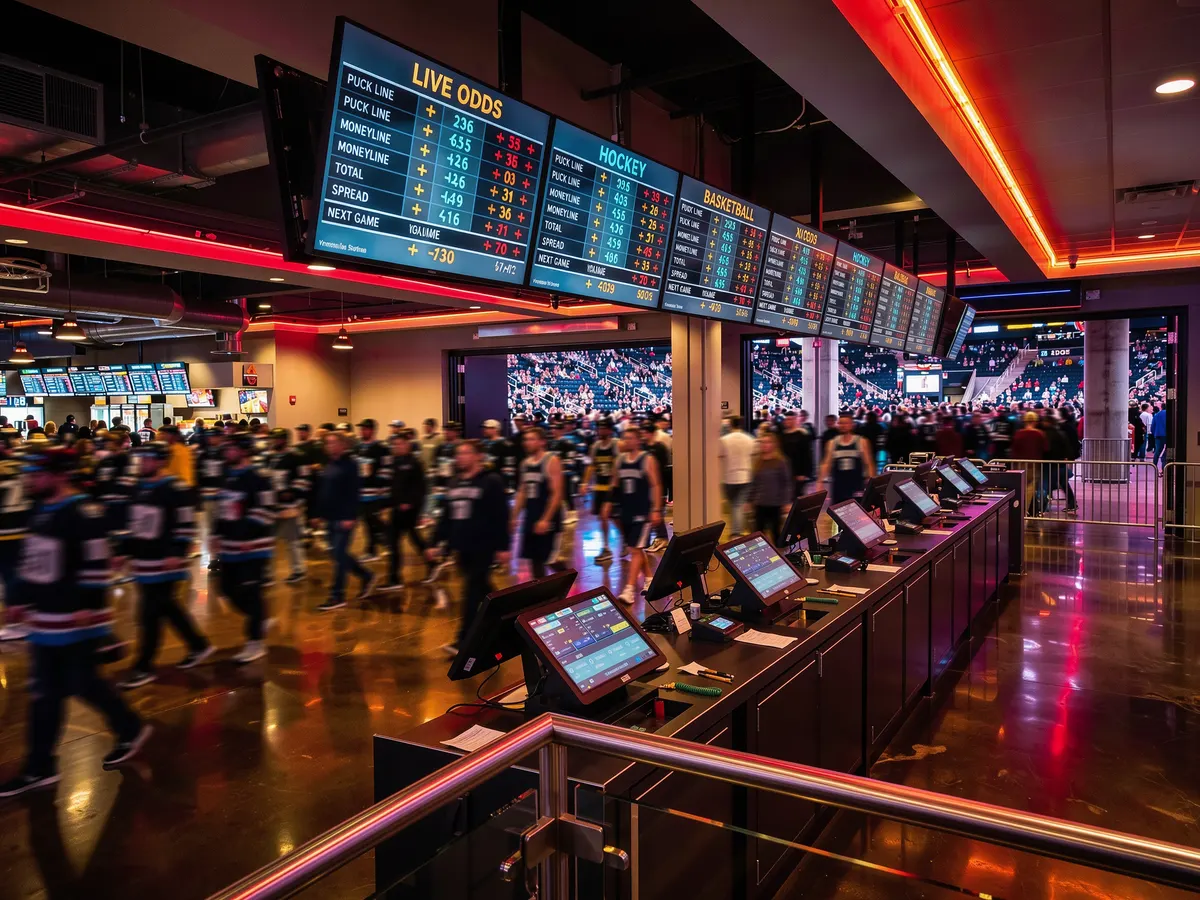
15:22 of the first period, and the building goes up
Trevor Connelly, 20 years old, playing the first NHL game of his life at left wing, puts the puck past the Chicago goaltender midway through the opening period. Shea Theodore, Victor Olofsson, Brayden McNabb and Tomas Hertl pile in to celebrate. That moment, on opening night of the 2026-27 season at T-Mobile Arena, is the sort of thing that moves Vegas sports betting interest well beyond the arena doors: a 5-2 win, a rookie’s first goal, a new head coach off the mark, and a city that suddenly has three teams worth watching in the same seven days.
The Golden Knights were the headline. They weren’t the only one. The Las Vegas Aces lost Game 2 of their first-round WNBA playoff series 99-89 in Indianapolis, which pushed a winner-take-all Game 3 back to Michelob ULTRA Arena on Thursday, Oct. 1, at 9 p.m. EST. And the Raiders, improbably 3-0, host the Kansas City Chiefs on Sunday at Allegiant Stadium. Three franchises, three different sports, one compressed calendar. If you want to understand how local betting demand behaves around marquee events, this is about as clean a sample as you’ll get.
What the Knights’ season opener actually showed
The question hanging over the Golden Knights going into the season was offence. They traded Pavel Dorofeyev, last season’s leading goal scorer, to the New York Rangers for draft picks, signed free agent Victor Olofsson to help cover the gap, and needed more from inside the room, starting with Jack Eichel.
Opening night answered it loudly, if only for one night. Five different Vegas players scored. Olofsson got the first goal of the season. Eichel finished with a goal and two assists. Theodore, McNabb and Ivan Barbashev each had two assists. Connelly, the club’s top prospect, scored on debut. Carter Hart stopped 24 of 26 shots. Ryan Craig picked up a win in his first regular-season game as head coach.
One game is one game. Five scorers spread across the lineup is the kind of detail that gets overweighted by casual bettors, though, and that matters for how prices move later in the week. More on that in a moment.
Thursday is the real pressure point: the Aces’ Game 3
The Aces won Game 1 at home on Sunday, Sept. 27, by 102-85. They looked comfortable. Game 2 went the other way: Indiana ripped off a 20-6 run in the second quarter to lead 48-43 at the break, then outscored Las Vegas 24-17 in the third. Caitlin Clark finished with 27 points, 15 assists and seven rebounds, with Kelsey Mitchell adding 26 and Aliyah Boston 22.
Vegas had scoring of its own. Jackie Young put up 31 points and five assists, A’ja Wilson 26 points and 15 rebounds. The defence was the problem, not the offence, and with a best-of-three now level at 1-1, everything funnels into one night at home.
Single-elimination games concentrate attention in a way regular-season fixtures never do. A season goes on; a Game 3 does not.
The week at a glance
Three events, three venues, three different kinds of stakes:
| Event | When | Venue | What’s at stake |
|---|---|---|---|
| Golden Knights vs Chicago Blackhawks | Season opener (completed) | T-Mobile Arena | Vegas won 5-2; Ryan Craig’s first regular-season win |
| Aces vs Indiana Fever, Game 3 | Thu, Oct. 1, 9 p.m. EST | Michelob ULTRA Arena | Winner-take-all first-round decider |
| Golden Knights vs Anaheim Ducks | Fri, Oct. 2 | T-Mobile Arena | Second home game of the new season |
| Raiders vs Kansas City Chiefs | Sun, 4:25 p.m. EST | Allegiant Stadium | 3-0 Raiders’ first test against a contender |
Why a crowded vegas sports calendar lifts betting demand
Betting handle follows attention, and attention follows meaning. A regular-season hockey game in January competes with everything else on a Tuesday. An elimination game, a season opener and a 3-0 team hosting Patrick Mahomes do not compete with anything; they are the thing. Nevada’s regulator publishes monthly sports betting figures, and the pattern across years is consistent: months loaded with high-profile, high-meaning events report more wagering activity than quiet ones. (Editors: link the latest Nevada Gaming Control Board monthly revenue report here.)
Three things stack up in a week like this one.
- Event density. Four local fixtures inside a week gives a recreational bettor four reasons to open an app instead of one.
- Narrative hooks. A rookie scoring on debut, Kirk Cousins leading the league with nine touchdown passes through three games, Brock Bowers back with 10 catches for 116 yards and a touchdown in a 35-27 win over New Orleans. Stories sell markets. Cousins’ and Mahomes’ numbers (seven touchdowns in three games) are exactly the kind of figures that end up stapled into player-prop and parlay slips.
- Local loyalty. Books in a team’s home market routinely take lopsided action on the home side. That’s a liability management problem for the operator, and it can show up in the price.
The trap hiding inside a big Vegas week
Here’s where smart beginners get caught. A packed schedule feels like opportunity, so the instinct is to bet more often, across more sports, in bigger combinations. The maths does not reward that instinct.
Sportsbooks build a margin into every market, the overround. Convert a price to implied probability (1 ÷ decimal odds) and total the outcomes in a market: the sum comes out above 100%, and the excess is the book’s edge. That edge applies to each leg you add. Stack four legs from a Thursday basketball game and a Sunday football game into one parlay and you are paying that margin four times over, which is precisely why multi-leg bets are so heavily promoted.
Heavy local money also does not make a home team more likely to win. If anything, public support on one side can shade a price in the opposite direction of where value sits, because the operator is balancing its book rather than forecasting the result. None of that is a system or an angle. It’s a reminder that busy weeks increase the number of decisions you make, and every extra decision is another encounter with the house margin.
How to treat a week like this one
Nothing exotic here, just the habits that separate people who enjoy a big sports week from people who regret it:
- Set the budget before the first puck drop, not after. Decide what the whole week is worth to you, then divide it. A Game 3 on Thursday should not borrow from Sunday.
- Treat one performance as one performance. Five different Knights scorers on opening night is a nice detail. It is not a trend yet, and markets price in small samples faster than fans do.
- Read the market, don’t react to the room. Public enthusiasm around a hometown side is information about bettors, not about the teams.
- Keep legs few and stakes small. Each added selection multiplies the margin you’re paying.
- Use the tools that exist. Deposit limits, loss limits, session timers and cool-off periods are standard at licensed operators. A week with four local events is exactly when they earn their place.
Betting carries a built-in negative expectation over time. Over any long run, the margin wins. If wagering stops being entertainment, step away and use self-exclusion or a national helpline rather than chasing a result.
What to actually watch
Thursday night at Michelob ULTRA Arena is the one with a hard ending. The Aces need a defensive answer for Clark, Mitchell and Boston after conceding 99; Young and Wilson have already shown they can score enough. Friday brings Anaheim to T-Mobile Arena for the Knights’ second home game, which will say more about whether the opener was a signal or a snapshot. Sunday at Allegiant Stadium is the genuine measuring stick: an unbeaten Raiders team, Ashton Jeanty working back from an ankle issue after 206 rushing yards in three games, against a Kansas City side that looks like a contender again.
For anyone following the Las Vegas market, the useful lesson isn’t who covers. It’s how quickly a city’s betting attention swells when three teams all matter at once, and how little that swell changes the arithmetic underneath.
Questions readers ask
Does higher betting interest change the odds?
It can move a price, but not for the reason most people assume. Operators adjust lines to manage exposure on each side. Heavy one-way money shifts the number so the book’s liability stays balanced; it is not a prediction that the popular side is more likely to win.
Why do big Vegas events matter more than regular fixtures?
Meaning drives volume. A winner-take-all Game 3 or a 3-0 team hosting a title contender pulls in people who don’t bet every week, which is why marquee dates account for an outsized share of activity in any market.
Is a packed sports calendar a good time to bet more?
More games means more opportunities to pay the bookmaker’s margin, not better odds. The sensible approach is a fixed budget for the week and fewer, smaller selections rather than more of them.