
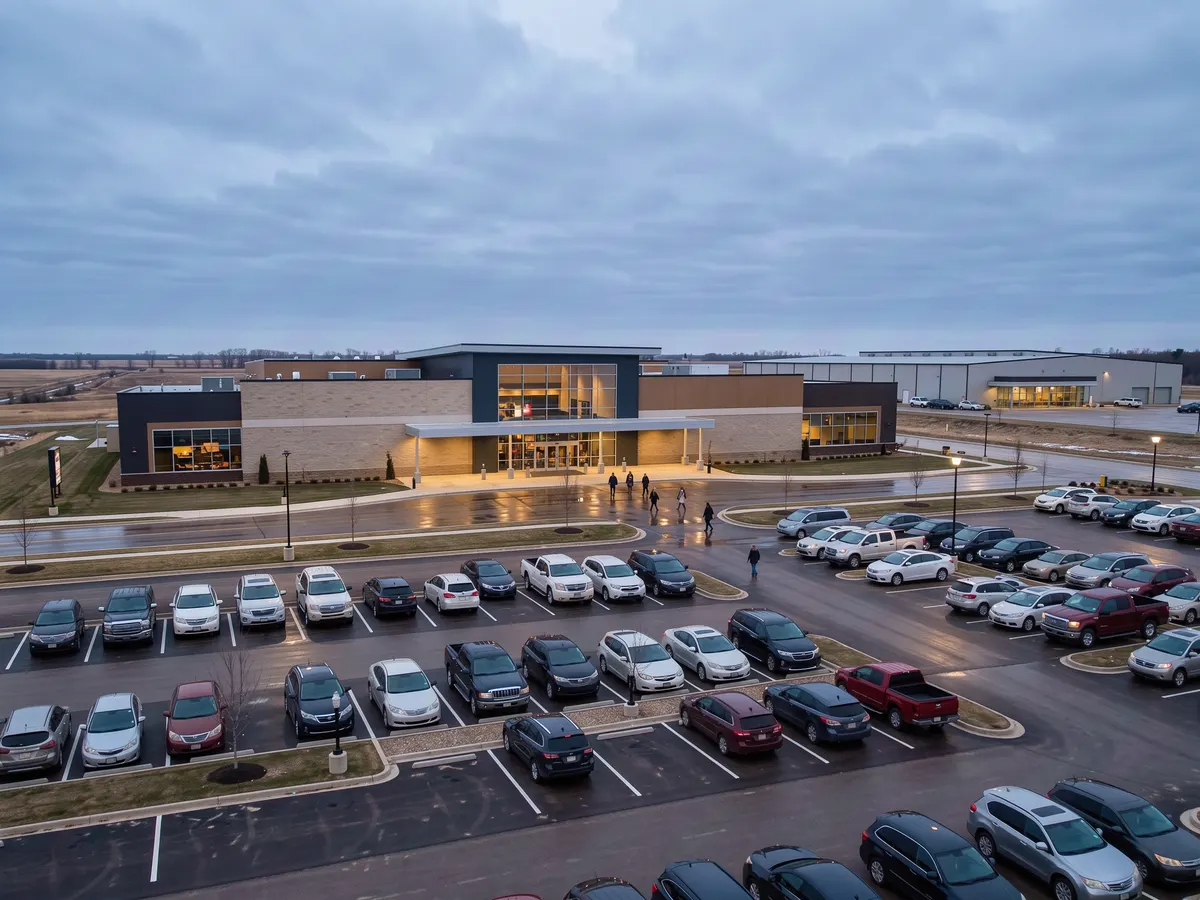
A full parking lot is not the same as a full casino floor
Drive past Fonner Park in Grand Island, Nebraska on an ordinary Monday afternoon and the apron in front of the Pinnacle Bank Expo Center is mostly asphalt. On October 5, with a sitting president scheduled to speak there at around 6 pm CST and doors opening at 1:30 pm, that same lot becomes the busiest piece of ground in central Nebraska. Directly across from it sits the $185 million Grand Island Casino Resort, which opened in April 2025.
Here’s the thesis, and it’s worth being blunt about: a high-profile political event will absolutely spike casino resort visitor traffic for a day, but the money in it is not gaming revenue. It’s hotel rooms, restaurant covers, and a one-time shot at putting thousands of in-state adults inside a building they have never walked into before. If you want to understand how regional casinos actually grow, this is a cleaner case study than almost any marketing deck.
The concrete facts behind the buzz
Elite Casino Resorts operates the property through a partnership with the Hall County Livestock Improvement Association, the organisation behind Fonner Park. The casino itself is 37,000 square feet with roughly 750 slot machines, 20 table games, a poker room and a sportsbook. Attached to it: a 162-room hotel with indoor and outdoor pools, three restaurants and bars, and a spa and fitness centre.
General manager Vince Fiala told local broadcaster KSNB that the property is planning for a large crowd on the Monday afternoon and evening, and gave the single most useful number in the whole story: room bookings have doubled since the visit was announced. He expects a full house, with guests arriving from around the state.
Context that explains the excitement in a town of this size — it’s the first stop by a sitting US president in Grand Island since George W. Bush came through in 2006. Nineteen years of nothing, and now it lands across the street from a six-month-old casino that is still introducing itself to Nebraska.
Why the hotel number is the one that matters
Doubled room bookings is a measurable, bankable outcome. It is also the cleanest signal in event-driven gambling demand, for three reasons.
- Rooms are capacity-capped, so the gain is real. With 162 rooms, a sell-out has a hard ceiling and a known value. Nobody has to guess whether it happened.
- An overnight guest spends across the property. Someone who drives three hours, checks in, eats dinner and stays over has a far higher chance of trying the floor than someone who parks, attends a rally and drives home at 8 pm.
- Food and beverage absorbs crowds that gaming can’t. Three restaurants and bars can serve far more people per hour than 750 slot machines and 20 tables can seat. On a single-event night, the kitchen is the bottleneck that converts.
Notice what Fiala did not claim: that the casino would win more money. That restraint is accurate. Gaming revenue is a function of time on device and amount wagered, and a crowd whose evening is built around a 6 pm speech has very little of the first.
Where Grand Island sits in the Nebraska market
Nebraska has five racetrack casinos, and the published figures make Grand Island’s position clear. Through August, the property won a little over $44 million from slots, tables and sports betting combined — third in the state, and well behind the two WarHorse venues in the big metro markets.
| Property | Gross gaming revenue (through August) | State rank |
|---|---|---|
| WarHorse Casino Omaha | $80.5 million | 1st |
| WarHorse Casino Lincoln | $63.5 million | 2nd |
| Grand Island Casino Resort | Just over $44 million | 3rd |
Figures as reported for the Nebraska market; the state’s two remaining racetrack casinos were not broken out in that reporting. Gross gaming revenue is what the house wins after paying out, not what players wagered.
Run the arithmetic and the strategic logic snaps into focus. Grand Island is averaging in the region of $5 million a month in GGR. Even a spectacular single day — a full hotel, packed restaurants, a busy floor — moves a monthly number by a rounding error. One night cannot close a $36 million gap to the market leader. What one night can do is introduce the building to several thousand adults who live within driving distance, in a market the property has only been competing in since April.
Trial, not takings: how regional casino marketing really uses an event
Regional casinos don’t live off tourists. They live off a repeat local and regional base, measured in visits per customer per year. Acquisition is expensive and slow. So when an outside organisation brings thousands of your exact demographic to a car park 200 metres from your front door, the prize is first visits, not first-day revenue.
The practical playbook on a night like this is unglamorous and mostly operational:
- Staff for the surge, not the average. Understaffed restaurants and long waits convert curiosity into a bad memory. Grand Island’s management has already flagged capacity planning publicly.
- Capture identity. Loyalty sign-ups, hotel reservation data and app downloads are the only assets from the night that still exist in November. Foot traffic that leaves no record is traffic you can’t re-market to.
- Sell the non-gaming product. Spa, pools, poker room, sportsbook — a resort has more reasons to return than a slot floor does, and the hotel is what makes a three-hour drive repeatable.
- Plan for the second visit before the first one ends. A dated offer redeemable weeks later is how a spike becomes a baseline. Without it, the bump is just a bump.
Worth noting the political backdrop, because it shapes the crowd: the visit comes ahead of the 2026 midterms, with the president expected to urge Nebraskans to keep Republican control of Congress and to back GOP candidate Brinker Harding in the 2nd District. Harding is running for the seat long held by Rep. Don Bacon, who is not seeking a sixth term, and is polling behind Democratic nominee Denise Powell. A rally crowd is a motivated, mostly in-state, overwhelmingly adult audience. For a casino’s purposes, that is a reasonable match — but it’s also a crowd that came for something else and will leave when it ends.
How you’d actually know if the bump worked
Don’t judge it on October’s revenue figures. Nebraska publishes monthly gaming numbers through its racing and gaming regulator, and a single strong day will be invisible inside them. The honest tests are slower:
- Does Grand Island’s share of statewide GGR drift upward over the following quarter, rather than for one week?
- Do hotel occupancy and food-and-beverage revenue hold above pre-event levels, or snap straight back?
- Did the loyalty database grow, and did those new members come back a second time?
Presidential visits, state fairs, concerts and big race days all create the same shape of demand: a sharp peak, a fast decay, and a small residue of genuinely new customers. The residue is the whole point. That’s the part worth paying attention to, and it’s the part almost nobody reports on, because it shows up quietly three months later.
One last thing, aimed at anyone planning to be in that crowd. A crowded floor on a one-off night doesn’t change the maths of any game on it. Every slot, table and sports market carries a built-in house edge, and short-term results are noise around a long-term negative expectation. Set a budget before you walk in, treat it as the cost of the evening, and use the deposit and session limits or self-exclusion tools available if gambling stops being entertainment. If it’s become a problem, free confidential help is available through national problem gambling helplines.